Resuming means any way the candidate returns to the test: clicking the test link again, reloading the page in the browser, or coming back after a while and letting the browser auto-reload.
When a candidate leaves a test mid-attempt — whether due to a browser crash, network issue, or accidental closure — AutoProctor determines whether to resume the previous attempt or create a new one. The behavior depends on your test type and settings.

Resume Behavior by Test Type

Test TypeResume BehaviorDetails
Socratease QuizAlways resumesLoads previous responses automatically; candidates must complete the existing attempt before starting a new one
Microsoft FormsNever resumesCreates a new attempt each time due to platform limitations
Google FormsConfigurableControlled by the Enable Auto Resume toggle and Google Forms autosave setting
IFrame TestsConfigurableControlled by the Enable Auto Resume toggle

Configuring the Resume Feature

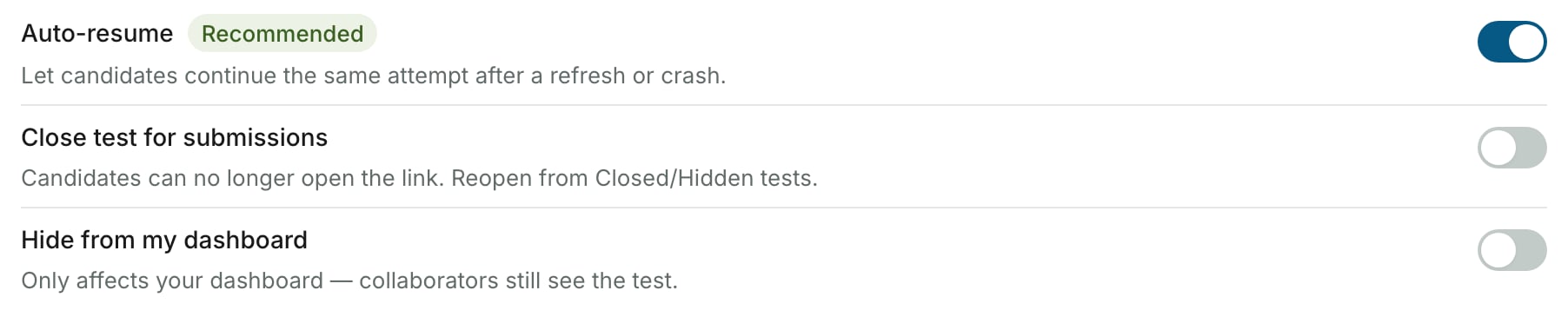
For Google Forms and IFrame tests, you control resume behavior through the Enable Auto Resume toggle in your test settings.
1

Open test settings

Navigate to your test on the AutoProctor dashboard and click Settings.
2

Toggle Enable Auto Resume

Find and enable or disable the Enable Auto Resume option.
Enable Auto Resume toggle in AutoProctor test settings
For Google Forms, you must also keep the Save Draft (autosave) setting enabled in Google Forms itself for resume to work properly. See Resuming Google Forms Tests for detailed configuration.

How Resumption Works

When a candidate returns to the test after disconnecting:
  • If resume is enabled: AutoProctor reopens the previous attempt. For Socratease quizzes, prior responses are restored automatically. For IFrame and Google Forms tests, whether responses are preserved depends on the external quiz platform’s own save/autosave behavior.
  • If resume is disabled: AutoProctor creates a new, blank attempt. The incomplete attempt still appears in your results.

How Timers Interact with Resumption

If you have timer settings configured, they affect how resumption works.

Test Duration

The remaining time from the original attempt carries over. For example, if a candidate starts a 60-minute test at 10:00 AM and disconnects at 10:30 AM, resuming at 10:50 AM gives them only 10 minutes remaining. Once the full duration expires (11:00 AM), the test can no longer be resumed.

Cannot Start Before / Cannot Start After

These constraints apply to the original start time, not the reconnection time. A candidate who started before the deadline can still resume after it, as long as the test duration has not expired.

Must Submit By

This deadline is strictly enforced at reconnection time. If the Must Submit By deadline has passed before the candidate tries to resume, the test does not load — even if the candidate originally started before the deadline.
The Must Submit By deadline overrides all other timer settings at resumption time. If this deadline has passed, the candidate cannot resume regardless of remaining test duration.